(Couldn’t help myself–thank you, Robin Williams.)
Great to connect via FaceTime, Mom. As promised, I am sending an update on our time in Vietnam. Where to start is the question.
We have heard such great things about Vietnam from friends who have traveled here. Most of the comments focused on the natural beauty of the Country. But as I reflect on our time thus far, my dominant thoughts are centered on the ubiquitousness of communist rule. Yes, the countryside is beautiful. But the inexcapable backdrop to everything we experience is a general lack of freedom that shapes the life of Citizens of Vietnam.
We have been fortunate to meet several Vietnamese people, a few in circumstances that allowed them to speak openly, which was incredibly insightful. I have spent time in communist and religiously restricted countries before, so the lack of open media, propaganda posters, even prohibited use of social media (in China, UAE, etc.) comes as no surprise. I had just mistakenly believed that Vietnamese citizens were living more of an open, Western life. This is clearly not the case.

Some examples of this include:
- Vietnamese people are not allowed to talk about politics, period. Discussing politics is grounds for arrest.
- Capital punishment is alive and well, as a means to maintain control of people. There are fourteen categories of “crime” that are punishable by death, many of which are vaguely defined. And once arrested, a subject can not expect representation or a fair trial anything like that which we are familiar with. Executions are done by firing squad, and beyond the death toll each year the larger effect is on the general population; it is through the application and looming threat of these consequence that the communist government leverages control over the people. For example, if you were to build a nice house the government would knock on your door demanding to see a financial paper trail that demonstrates how you were able to pay for the house. If you could not produce acceptable documentation, you would be arrested for “corruption.” If you were walking down the street and discussing politics, expressing your thoughts and opinions, you could be arrested. The Vietnam people are well aware of these threats, and conduct themselves accordingly. Communist control.
- Families are only allowed two children in Vietnam. One way the government controls this is through wages. The most coveted–highest paying and most stable–jobs in Vietnam are government jobs (the communist government owns and controls most of that which provides employment, and is the country’s largest employer). If you are working in a government job, one child is ok, two are allowable, but if you have a third your wages are cut by 50 percent. This is in a country where the typical Vietnamese family has three generations living in a single household because they need to share living expenses to survive. Now imagine another mouth to feed and your wages are cut by 50 percent. Government imposed birth control.
- It is only recently that Vietnamese citizens are allowed to own a business.
- Anyone alive in the 1970s lived through times when citizens were not free to leave the Country. Even now, travel requires special permissions and most can not afford to travel.
- And when applying for jobs, an individuals resume has to include details of extended family connections for three generations. You have an uncle who was on the “wrong side” of things in the 1970’s? College degree doesn’t matter, no job for you.
What has been interesting to observe is how the degree of “oppression” felt by people changed as we traveled South to North changed. The country is a long, narrow strip that extends from the Southern border of China down to the South China Sea. (We learned almost immediately that the Vietnamese refer to the South China Sea as the “East Sea”; lingering evidence of a long hostile relationship with their neighbors to the North.)

Our time in Vietnam began in Ho Chi Minh City (formerly, and still most frequently referenced as, Saigon). We then traveled North to the central area of the country and spent time in Hoi An. And finally, we spent a few days in Halong Bay, quite near the Chinese border.
As we traveled, we experienced a change in the people’s acceptance of communism that we did not anticipate. Based on our general understanding of the history of Vietnam we thought the hold of communism would be much stronger, worse, in the North. However we observed something quite different. The people in the South seemed to feel much more oppressed by communism. For example one of our guides in Saigon made an escape attempt in the ’70s when he was 12 years old. He nearly died trying to get out of the country, was captured and sent to prison for three weeks while they decided what to do with him. And this gentleman shared quite a lot about the realities of living in communist Vietnam, then and now. The guide we had the next day made a point of explaining, “We know we could have a better life if we had been born somewhere else, but we were born here so what are we going to do? We find a way to be happy.”


Motorbike is the dominant mode of transportation in all of Vietnam. It is typical to see a family of three or four on a single scooter, people hauling large quantities of goods and even livestock being transported on a motorbike.
And as we moved on to central Vietnam, the mood changed a bit. The people seemed incrementally less affected by the realities of communism. One of our guides for a day spent on The Mekong made a statement that well summarized what we were observing, “Now we have a better life compared to 40 years ago…we are satisfied, but not yet happy.”


By the time we reached Halong Bay in the North of Vietnam, evidence of communism seemed harder to identify. Tourism-based development was simply beyond anything I have seen anywhere in the world. Hotels, resorts, amusement parks, beaches, new highways and bridges–all of it being built on hope of grander days, none of it yet occupied. Outright optimism.


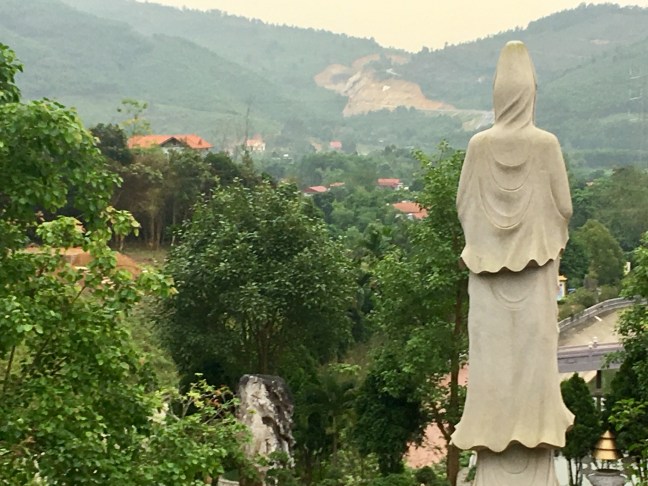
Halong Bay is stunningly beautiful.
The only way I can make sense of this change of mood as we moved South to North is to remember that it was the North that “conquered” the South, thus the lingering hardship and difficulty in acceptance among Southern Vietnamese people? (I state this as a question.)
The closest thing I can muster in personal experience is some of the shocking conversations I have had in the American South when traveling at home. I recall my first business trip to The South when I was asked more than once “how many boys we lost in the war”, meaning how many members did my family lose in The Civil War. (What? Really? Yah, and this was in the 90’s. That took a while to digest.) Maybe, just as The Civil War has more of a lingering presence in The South, communism is felt more oppressively in Southern Vietnam. I don’t know.
And the more I learn about The Vietnam War, the more out of my depth I feel. America clearly made mistakes, and took far too long to exit. However the general fight against the spread of Communism and related human oppression has merit. It seems clarity can be more easily gained with limited perspective and closeness of proximity–by relation or geography. The more comprehensive the view, the more complicated it gets.
Well I am realizing that this update is getting long. I hope not boring, but long nonetheless. There is so much more I can share with you when we get home. Remind me to tell you about healthcare, it is quite eye-opening!
Off to Hong Kong now.
We love you,
Shannon and Dan
 Notes to Mom